Technical Information - Trailer Couplers and Hitch Balls
CLICK HERE to shop for Trailer Couplers, Balls and Safety Chains
I. COUPLER USE, MAINTENANCE & INSTALLATION TIPS:
BEFORE TOWING
Check vehicle hitch, ball, and coupler for signs of wear or damage. Replace any parts that are worn or damaged before towing.
Know your trailer plus added load weight. Do not exceed lesser of coupler, vehicle, ball, or trailer weight ratings. Use only the ball diameter indicated on your coupler. Use of any other ball diameter will create an extremely dangerous condition which can result in separation of the coupler and ball or ball failure.
Be sure the coupler is secured to the hitch ball and the lock lever or hand wheel is down tight and locked. Clamp hand wheel couplers hand tight only. Assure that the ball clamp is properly nested under the ball and not sitting on top of the ball. Recheck tightness again after towing about 50 miles
Check that trailer safety chains are properly connected.
Check that all trailer lighting is hooked up and working correctly.
RECOMMENDED MAINTENANCE
Smear ball socket and clamp face with chassis grease.Periodically oil pivot points and sliding surfaces of coupler with SAE 30 wt. Motor oil.
When parking or storing your trailer keep the coupler off the ground so dirt will not build up in the ball socket.
II. COUPLER INSTALLATION/WELDING DIAGRAMS:
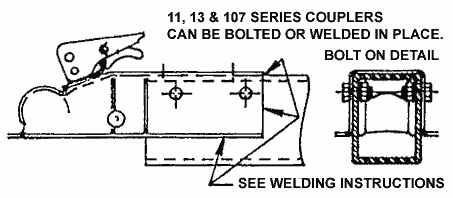
INSTALLATION INSTRUCTIONS FOR CLASS-1 COUPLERS
Use 1/8" Fillet Weld as shown below. Use No. E6011 A.W.S Welding Rod (AC RO DCAP) 1/8" Dia. Set machine AMPS at 105/115 with 18/22 Volts.
AFTER INSTALLATION IS COMPLETE CHECK THAT COUPLER OPERATION HAS NOT BEEN IMPAIRED IN ANY WAY.
Assure coupler internal stop is butted against end of trailer tongue for maximum overlap.
The preferred method is to use (4) 3/8" Bolts through side holes and torqued to 15/20 ft. lbs. (see illustration below) An alternate method is to use (2) 3/8" grade 5 through bolt & locknuts providing they can be torqued to at least 20 ft. lbs. without excessive deformation of the coupler or the trailer tongue.
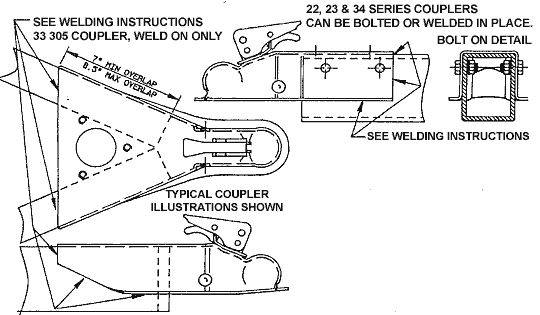
INSTALLATION INSTRUCTIONS FOR CLASS-2 AND CLASS-3 COUPLERS
Use 1/8" Fillet Weld as shown below. Use No. E6011 A.W.S Welding Rod (AC RO DCAP) 1/8" Dia. Set machine AMPS at 105/115 with 18/22 Volts.
AFTER INSTALLATION IS COMPLETE CHECK THAT COUPLER OPERATION HAS NOT BEEN IMPAIRED IN ANY WAY.
Assure coupler internal stop is butted against end of trailer tongue for maximum overlap.
The preferred method is to use (4) 1/2" Bolts through side holes and torqued to 30/35 ft. lbs. (see illustration below) An alternate method is to use (2) 1/2" grade 5 through bolt & locknuts providing they can be torqued to at least 35 ft. lbs. without excessive deformation of the coupler or the trailer tongue.
III. HITCH BALL USE & INSTALLATION TIPS:
TIGHTEN NUT WITH TORQUE WRENCH AS FOLLOWS: 3/4" DIA. THREAD: 150 LB.-FT. 1" DIA. THREAD: 250 LB.-FT.
Use hitch ball only for towing trailers or vehicles connected to the ball with a socket type coupler.
Ball diameter must match coupler socket size.
Do not exceed gross trailer weight shown on ball, or any other part of towing system, if lower.
Attach to platform at least 3/8” thick. Mounting hole must not exceed ball threaded shank diameter by more than 1/16”.
Always use lock washer, and position washer next to nut.
Threaded shank must protrude beyond bottom of nut when tightened. If it does not, ball shank is too short for the application and loss of attachment may occur.
Check nut tightness every time you hook up the trailer and at the beginning of each towing day. Tow only if nut is tightened as specified. Tighten with torque wrench as follows: 3/4” shank to 150 lb.-ft. , 1” shank to 250 lb.-ft.
Replace any damaged or worn part (except finish).
Never attach a tow rope, chain, or stretch type elastic rope to hitch ball.
Do not fasten trailer safety chain or any other type of attachment to, or with, the ball.
Lubricate ball and coupler to minimize wear and friction. Coupler must not bind on ball.
IMPROPER TIGHTENING CAN CAUSE BALL FAILURE OR LOSS OF ATTACHMENT